MOBILITY · URBAN POLICY

How can a city center overhaul its parking system without hurting its commercial appeal?

A mid-sized French city of 95,000 residents is preparing to overhaul a paid-parking system left unchanged for twelve years: an extended perimeter, revised rates, zone-based modulation, dematerialized payment. The projected budget target is €2.8 million a year.

Two risks frame the decision. A city-center retail sector already weakened by out-of-town competition and e-commerce. And a topic several cities have learned can, if poorly calibrated, cost lasting political capital.

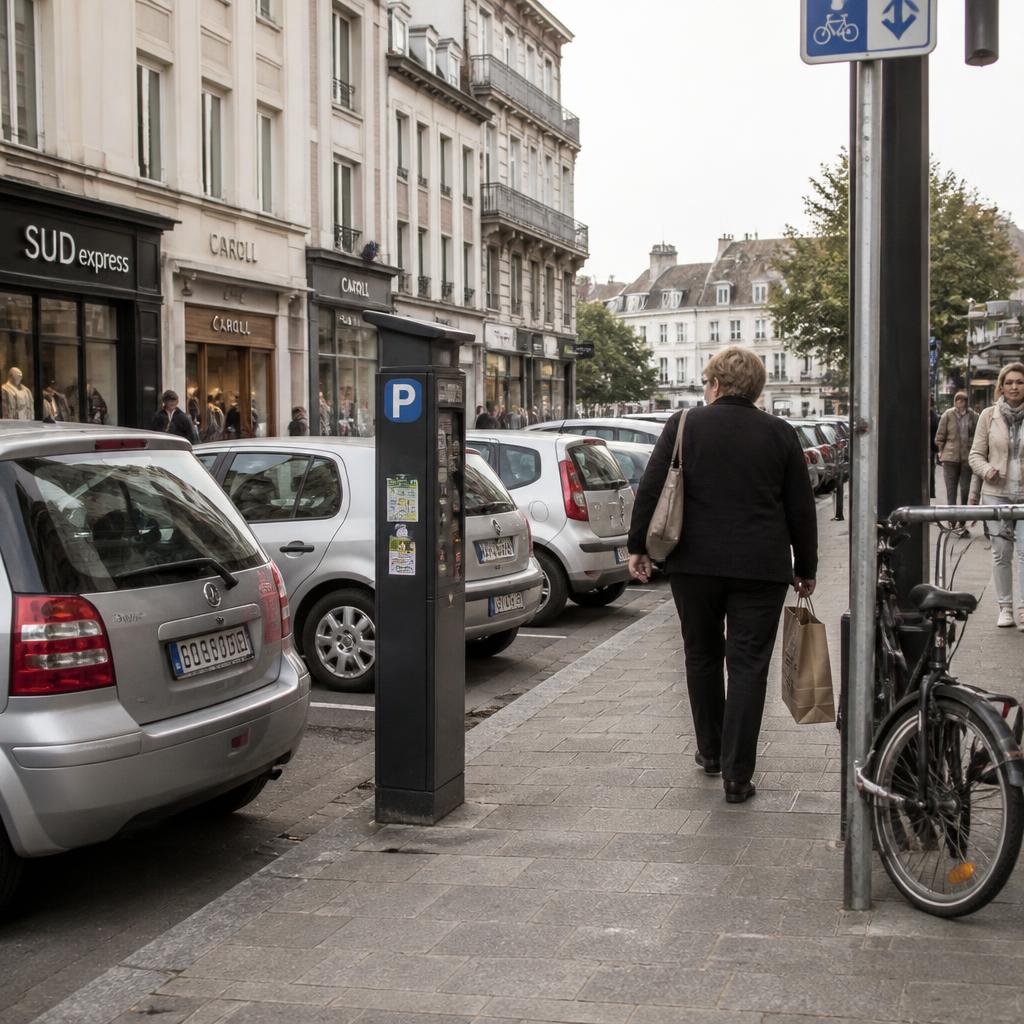
A shopping street in a mid-sized city: cars parked along the curb, a pay station, passers-by and a bicycle chained to a rack, late morning.
Decision
Overhaul the paid-parking system
Population
180,000 residents and workers, 13 profiles
Horizon
18 months of commercial and political trajectory
Stakes
€2.8M projected yield, a fragile city-center retail sector

THE PROBLEM

Parking
is not static.

Changing a price, a duration, a zone, a subscription or an exemption does not only change where cars stay parked. It changes what people do around that spot.

The choice of transport mode, the length of the visit, the destination of a purchase, the time spent looking for a spot, the use of a parking garage, an employee's arrival time: all of these behaviors reshuffle at the same time, and not in the same direction for every user.

A parking decision therefore produces a cascade of behaviors. The useful question is not whether residents approve of the rule, but what different populations will do once it changes.
What is the same for everyone

  • a system unchanged for twelve years
  • a mid-sized city of 95,000 residents
  • a planned extension of the paid perimeter
  • a proposed zone-based rate modulation
  • a shift to dematerialized payment
  • a budget target of €2.8 million a year

What differs for each person

  • place of residence and distance to the center
  • professional mobility constraints
  • actual length of time spent in the city center
  • existence of a credible alternative to the car
  • relationship to city-center retail
  • age and familiarity with digital tools

ASKING THE RIGHT QUESTION

“Are you in favor
of paid parking?”

says nothing

about what will happen.

An opinion about a rule does not describe a behavior. A user opposed to it may carry on exactly as before for lack of an alternative. An indifferent user may give up a shopping trip without ever voicing opposition.

  • Parking duration
  • Displacement location
  • Retail destination
  • Payment method

The useful question is therefore: what does each person do when the rule changes, and above all, what do they do next. It is this sequence of adjustments, not the initial opinion, that determines the policy's real effect.

PROPAGATION

A rule can work
where it applies

and produce an effect

elsewhere.

That is the distinctive feature of this decision. It cannot be read at the scale of the regulated spot, but at the scale of the system around it: neighboring streets, parking garages, peripheral retail zones.

  1. 01Rule changedA rate, a perimeter, a maximum duration, a payment method change.
  2. 02BehaviorEach person adjusts whatever they can adjust: duration, timing, method, destination, or nothing at all.
  3. 03DisplacementSome do not give up on the car. They shift the parking, the errand, or the purchase toward the periphery.
  4. 04New equilibriumTurnover, retail footfall and budget yield settle at a level that was not the one intended.

This chain is a tool for analysis, not a result. It describes what the simulation seeks to make visible: not just the initial reaction to a rule, but the behaviors that can follow it.

ONE DECISION, SEVERAL OBJECTIVES

These objectives
are not always

compatible with one another.

Budget yield

€2.8 million in projected additional revenue, amid strained municipal finances.

Retail vitality

Merchants already exposed to peripheral retail zones and e-commerce.

Spot turnover

Freeing up spots for short visits rather than all-day parking.

Political acceptability

Several municipal precedents where parking policy durably cost political capital.

WHAT IS BEING TESTED

One city center.
Five configurations.

The protocol does not compare opinions about paid parking. It confronts five schemes genuinely considered by the city with a population whose mobility habits differ.

  1. 01Uniform rate overhaulThe same increase and the same rule across the entire extended paid perimeter.
  2. 02Zone-based modulationDifferentiated rates, with a retail zone kept at the lowest rate.
  3. 03First thirty minutes freeFree entry across the whole paid perimeter, payment beyond thirty minutes.
  4. 04Conditional free parkingFree parking tied to a retail purchase, validated by city-center merchants.
  5. 05Hybrid overhaulA combination of several mechanisms: free entry period, moderate modulation, partial dematerialization.

2,400 synthetic users were surveyed on the five pricing configurations and on payment methods, with dynamic follow-up on tipping-point moments: giving up an errand, choosing a peripheral retail zone, adopting the mobile app.

“Driver”
describes no behavior

at all.

SIMULATED POPULATION

The reconstructed population covers 180,000 residents, workers and occasional visitors of the metropolitan area, calibrated on INSEE data, regional studies on mobility in mid-sized cities, and the city's own proprietary data on parking habits.

It is structured into 13 profiles crossing place of residence, professional mobility constraints, relationship to city-center retail, age, and familiarity with digital tools. Two people parked side by side do not necessarily belong to the same profile.

  • City-center residents

    long-duration daily parking, little room to adjust, highly sensitive to the perimeter

  • Occasional city-center shoppers

    short shopping visits, quick trade-off between city center and peripheral retail zone

  • Metropolitan commuters

    all-day parking, fixed schedule constraint, alternative dependent on transit service

  • Traveling professionals

    short, repeated stops, utility vehicle, constrained by load and proximity

  • Senior users

    habits built around physical payment, resistance to exclusively digital payment, regular visitors to the center

  • Occasional visitors to the metropolitan area

    unfamiliar with the system, highly sensitive to entry friction and rule clarity

  • Multimodal users

    a credible alternative already available, quick to switch as soon as cost or constraint rises

  • Remote households with no alternative

    the car is not substitutable, adjustment possible only on duration or destination

These configurations make visible part of the population's heterogeneity. The simulation covers synthetic individuals, not a handful of representative personas.

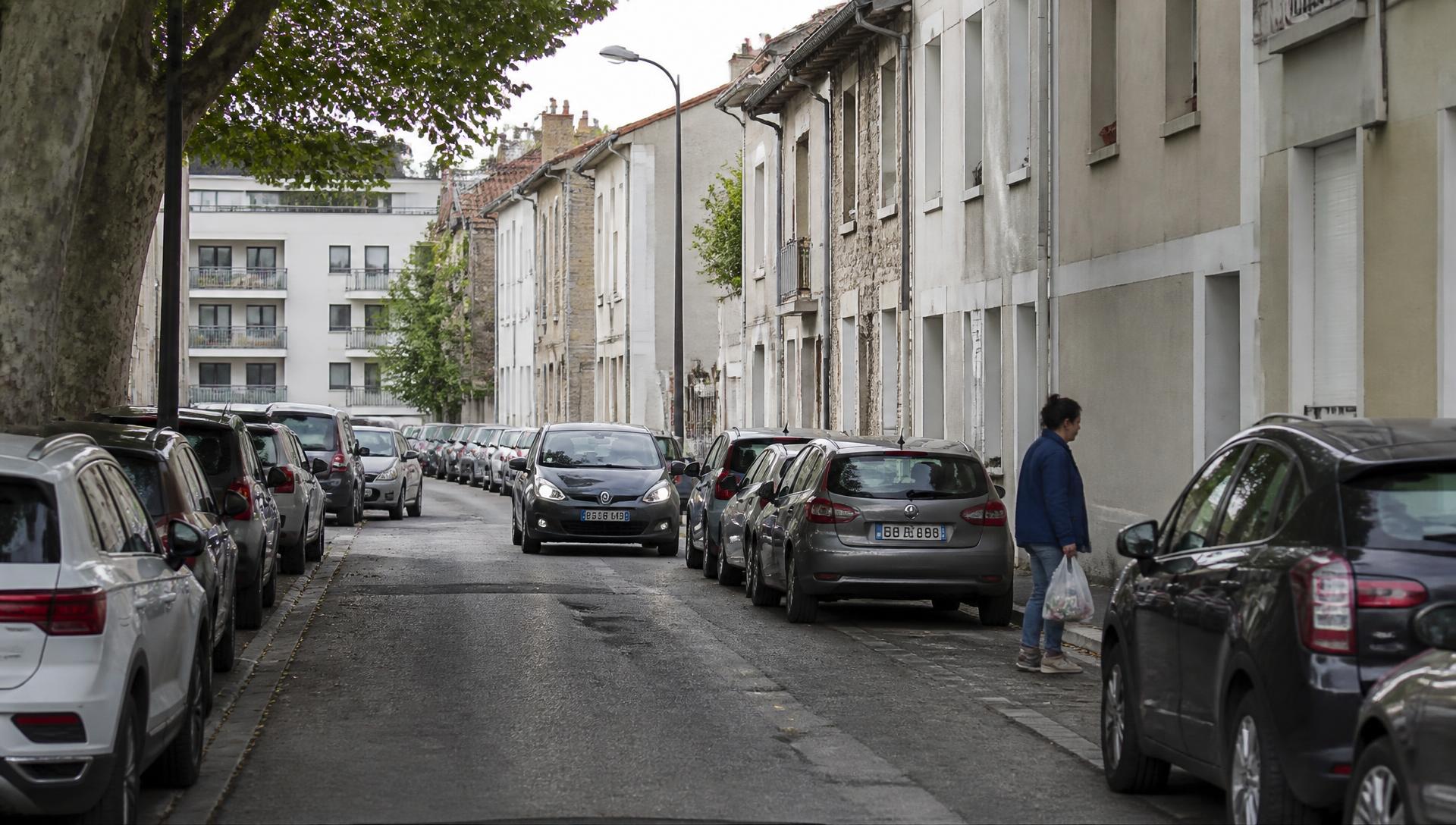
A residential street near the center: cars parked bumper to bumper on both sides, a driver looking for a spot, a resident walking home with groceries.
A few streets away from the regulated perimeter. This is often where the effect of a decision made downtown becomes visible.

REACTIONS

What is at stake
is not a vote on the rule.

  1. 01

    Price does not have the same effect regardless of duration

    Zone-based rate modulation does little to protect retail: potential customers give up the quick shopping errand regardless of the rate, anticipating the hassle of paying. It is not the amount that blocks the twenty-minute visit, it is having to pay at all.

  2. 02

    A free entry period removes friction, not a cost

    A free first thirty minutes across the whole perimeter protects retail vitality significantly better than a discounted retail zone. It symbolically validates the legitimacy of the quick errand and removes the entry friction from the paid system.

  3. 03

    Removing a channel shifts the problem onto those who cannot keep up

    Exclusively digital payment achieves 42% acceptance, with strong resistance from senior users and occasional visitors. Combined with pay stations kept in high-traffic zones, it reaches 74%. The physical channel acts as a symbolic safety net, even for those who actually use the app.

  4. 04

    Turnover drives yield, not just the rate

    The scheme combining a free entry period with moderate modulation generates a yield equivalent to the uniform overhaul. Users stay for less time, which multiplies the number of paid tickets beyond the free half-hour. Retail protection and budget yield do not trade off against each other here.

Imagine All The People does not ask a model whether a parking policy is good. Five schemes are confronted with a heterogeneous synthetic population, in order to observe who adjusts their duration, who changes destination, who simply moves their car, and who cannot change anything at all.

RESULT

Five configurations,
read across four dimensions.

ConfigurationTurnoverAcceptabilityCity-center appealDisplacement risk
01Uniform rate overhaul across an extended perimeterhighlowlowhigh
02Zone-based modulation, retail zone preservedmediummediummediummedium
03First thirty minutes free across the whole perimeterhighhighhighmedium
04Conditional free parking tied to a retail purchasemediummediummediummedium
05Hybrid overhaul: free entry period, moderate modulation, physical channel preservedhighhighhighmedium

Comparative reading drawn from the simulated reactions. The displacement-risk column reads in reverse of the others: a high level signals a likely shift of parking toward neighboring streets or the periphery. No configuration is the best on all four dimensions at once.

The most robust

Free first thirty minutes + moderate modulation + pay stations preserved + support for senior users

The most fragile

Uniform increase across an extended perimeter + exclusively digital payment

6% increase in city-center retail footfall · €2.4M annualized budget yield · 71% of transactions made via the mobile app · 29% of transactions made at the pay station The city adopted the hybrid configuration. No lasting political mobilization emerged. Two adjustments followed: a reduced rate window on Saturdays and a resident subscription.

LESSON

The goal was never
to optimize the price of a spot.

It was to understand

the system around it.

What blocked the quick shopping errand was not the ticket price, but the entry friction of the paid system. A rate modulation, however fine-tuned, did not remove that friction. A free entry period did.

And the budget yield, which was assumed to trade off against retail vitality, turned out to be driven by turnover as much as by the rate. It was not a trade-off: it was a second-order consequence that a purely price-based reading could not reveal.

To differentiate
Short-duration uses and all-day parking, which do not respond to the same lever.
To protect
Users with no credible alternative and those a fully digital system would leave behind.
To monitor
Displacement: toward neighboring streets, toward parking garages, toward peripheral retail.
To evaluate
The scheme at the scale of the urban system, not only at the scale of the regulated zone.

POSSIBLE FUTURES

One city center.
Three policies.

A

INCREASE

A uniform rate increase across an extended paid perimeter

  • clear signal, single rule, simple to implement
  • budget yield reached faster
  • quick shopping errands to the city center are given up
  • displacement toward neighboring streets and peripheral retail

B

DIFFERENTIATE

Rates and rules adapted to pressure and location

  • finer targeting of long-duration uses
  • retail zone preserved on paper
  • entry friction maintained: the quick errand remains discouraged
  • lower clarity of the system for occasional visitors

C

REORGANIZE

Free entry period, moderate modulation, physical payment channel preserved, support measures

  • the short visit becomes possible again without friction
  • increased turnover supports the budget yield
  • users far from digital tools stay within the system
  • several levers to coordinate and adjust after rollout

WHAT THE SIMULATION DOES NOT DO

It does not settle
the place of the car

in the city.

This case defends neither the car, nor its disappearance, nor free parking, nor paid parking. It describes behaviors, constraints, available or absent alternatives, and the observable consequences of five different rules.

The objectives being pursued — yield, turnover, protecting residents, retail vitality, use of public space — remain political choices. The simulation makes them comparable. It does not rank them.

METHOD

Before recommending,
we made people react.

  1. DECISION
  2. POPULATION
  3. STRATEGIES
  4. DYNAMIC REACTIONS
  5. COMPARISON
  6. ARBITRATION

Trajectories were projected over 18 months, modeling the commercial impact on the city center and the political trajectory of the policy. This case adds a capability to the library: exploring second-order effects, when a local decision spreads beyond its perimeter.

A real case.
An unnamed city.

This case comes from a simulation carried out for a mid-sized French city. The local authority is not named, no personal data was entered into the system, and the detailed results remain the client's property. The comparisons published here are qualitative and do not constitute a traffic or revenue forecast.

Your next decision

Which decision do you want to explore?

Describe your need. We can point you to the right level of support.

What if you tested
your next decision?

State your decision. See the future it produces.

Explore the product