PUBLIC HEALTH · ANTICIPATION

“ Anticipating population behavior in the face of a moderate epidemic resurgence. ”

A national health authority was conducting a preparedness exercise for a scenario involving a moderate resurgence of a respiratory disease with community transmission, comparable in intensity to severe seasonal influenza. Recommended, non-mandatory protective measures. Post-COVID context marked by structural health-measure fatigue.

The question was not epidemiological : existing models were sufficient to project viral circulation. It was behavioral. How will a population that has already lived through a crisis react if the risk returns without returning to the same level of severity?

Inside a tram during the day: seated and standing passengers, most without protection, one person wearing a mask near the door.
DECISION
Prepare the communication setup of a national health authority for a moderate epidemic-resurgence scenario
POPULATION
4,8 million synthetic adults, 9 profiles of relationship to health risk
WHAT IS TESTED
4 institutional communication strategies
HORIZON
12 weeks of behavioral trajectories

THE PROBLEM

The second time,
we never react
as we did the first.

A population that has lived through a health crisis does not meet the next signal as a blank slate. It carries experience, memories, habits acquired then abandoned, trust or distrust in institutions, a perception of the social and economic costs of measures, and fatigue with certain practices.

The question posed by the national health authority was therefore not “ will people follow the recommendations ? ”. It was : what would effective adoption of recommended protective behaviors be in a context of post-COVID institutional distrust, and how would institutional communication strategies influence those behaviors ?

The health authority used our system to test four institutional communication strategies on a differentiated synthetic population, with behavioral trajectories projected over twelve weeks.

WHAT THE SCENARIO ASSUMES

  • a preparedness exercise conducted outside a declared crisis situation
  • an assumed scenario of a respiratory disease with community transmission
  • an intensity comparable to severe seasonal influenza
  • assumed occasional pressure on hospital capacity
  • recommended, non-mandatory protective measures
  • a post-COVID context marked by structural health-measure fatigue

WHAT DIFFERS FOR EACH GROUP

  • age and epidemiological vulnerability
  • occupational exposure
  • trust in institutions
  • involvement in post-COVID social movements
  • personal and family experience of the previous crisis
  • actual ability to change travel and work patterns

A VARIABLE : MEMORY OF RISK

A population
that remembers
does not hear
the same signal.

  1. 01WHAT THE POPULATION HAS ALREADY EXPERIENCEDA full health crisis, with its measures, announcements and social and economic consequences.
  2. 02WHAT IT RETAINEDA stock of health-related behavioral capacity — voluntary mask wearing, interpersonal distancing, spontaneous remote work — that it knows how to mobilize without waiting for an instruction.
  3. 03WHAT THIS CHANGES FOR THE SIGNALIn 5 territories out of 10, behavioral self-regulation precedes official measures by 8 to 14 days. The institutional message arrives after the movement.
  4. 04WHAT THIS IMPLIES FOR THE DECISIONA moderate epidemic resurgence does not meet a blank-slate population. It meets a population that remembers, and that already has opinions about what worked.

STATED FATIGUE, ACTUAL FATIGUE

A measure accepted
the first time
is not accepted
in the same way
the second time.

Individuals have learned what they consider effective, what they now refuse, and what they are willing to resume temporarily. What the case documents is not a level of weariness, but the gap between what is stated and what is actually reactivated.

  • WHAT AN OPINION SURVEY MEASURES68 % of adults report high fatigue with health measures.
  • WHAT THE BEHAVIORAL SIMULATION MEASURES42 % show effective resistance to the recommended protective behaviors.
  • WHAT THE GAP SHOWSThe asymmetry between stated fatigue and behavioral fatigue is structural. It is not a one-off measurement error.
  • WHAT THIS IMPLIESA setup calibrated to stated fatigue underestimates the population’s mobilizable capacities and misses its objective.

A MECHANISM : THE PERSONAL THRESHOLD

Behavior does not change
does not track
the risk
continuously.

THE SAME SIGNAL, DIFFERENT TIPPING THRESHOLDSHIGH OCCUPATIONAL EXPOSURECLOSE TO A VULNERABLE PERSONSTRONG MEMORY OF THE PREVIOUS CRISISHIGH FATIGUE WITH MEASURESLOW INSTITUTIONAL TRUSTWEAK SIGNALESTABLISHED SIGNALCONCEPTUAL DIAGRAM. NO THRESHOLD VALUE IS MEASURED : ONLY THE DISPERSION OF THRESHOLDS IS DOCUMENTED BY THE CASE

Conceptual diagram. No threshold value is measured : the diagram only shows that the same rise in the signal does not trigger the same behaviors in everyone.

What the case documents is the dispersion of these shifts : in 5 territories out of 10, part of the population adapts its behavior 8 to 14 days before any official measure, while others change nothing under the same conditions.

WHAT IS TESTED

Four strategies
of institutional
communication.

What varies is not the recommended health content, but the architecture of public messaging : who speaks, from what level, and in what register. No additional health measure is simulated.

  1. 01FIRM, PRESCRIPTIVE COMMUNICATIONA national injunction-based register directly stating the expected behaviors.
  2. 02INFORMATIVE, RESPONSIBILITY-BASED COMMUNICATIONAn informational register, leaving each person to decide how to adapt.
  3. 03TERRITORIAL COMMUNICATION CASCADE THROUGH PREFECTURESThe same setup rolled out department by department, with each prefect communicating with local elected officials.
  4. 04COMMUNICATION VALIDATING OBSERVED SELF-REGULATIONA register that builds on behaviors already adopted by the population and makes them visible.

4 200 synthetic adults were interviewed individually on the 4 strategies tested. Dynamic agents conducted behavioral interviews, following up with each adult on tipping points : perception of the threat, adoption of protective behaviors, resistance to collective arrangements, mobilizable health fatigue. Trajectories were projected over 12 weeks, modeling territorial and intergenerational dynamics.

A population
is not
“ the cautious
and the reckless ”.

SIMULATED POPULATION

The reconstructed population covers 4,8 million European adults, calibrated on public INSEE data, Santé publique France data and European post-COVID studies of health behavior.

It is structured into 9 profiles of relationship to health risk, crossing age, epidemiological vulnerability, occupational exposure, institutional trust and engagement in post-COVID social movements. This heterogeneity determines what shifts and what does not.

  • AGE AND VULNERABILITY

    stated epidemiological position changes how the same signal is interpreted

  • OCCUPATIONAL EXPOSURE

    some work situations make adaptation difficult, regardless of intention

  • INSTITUTIONAL TRUST

    it determines what is heard in a national message

  • POST-COVID ENGAGEMENT

    involvement in social movements arising from the previous crisis structures reception

  • MOBILIZABLE FATIGUE

    willingness to readopt an already-tested practice, distinct from stated fatigue

  • SPONTANEOUS SELF-REGULATION

    behaviors adopted before any official announcement

  • TERRITORIAL EMBEDDEDNESS

    local and national voices do not carry in the same way

  • INTERMEDIATE TYPOLOGIES

    nine profiles of relationship to risk, crossing these dimensions rather than opposing them

These configurations reveal part of the population's heterogeneity. The simulation operates on synthetic individuals, not a handful of persona types : these are not representative figures, but distinct situations, constraints and options.

REACTIONS

What drives change
behaviors
is not
the intensity of the message.

  1. 01

    THE POPULATION DOES NOT WAIT FOR OFFICIAL ANNOUNCEMENTS TO ACT

    The simulation identifies a structural post-COVID dynamic: in 5 territories out of 10, behavioral self-regulation — voluntary mask wearing, interpersonal distancing, spontaneous remote work — precedes official measures by 8 to 14 days. The population has behavioral capital that it mobilizes without waiting for instructions.

  2. 02

    VALIDATING WHAT IS ALREADY BEING DONE CARRIES MORE WEIGHT THAN PRESCRIBING WHAT SHOULD BE DONE

    A register that gets ahead of behavior generates 34 % effective adoption of protective behaviors. A register validating observed self-regulation — “more and more of you are wearing masks on public transport: this behavior makes a collective difference” — generates 76 %. The expected behavioral content is identical in both messages.

  3. 03

    STATED HEALTH-MEASURE FATIGUE IS MISLEADING

    68 % of adults report high fatigue with health measures; only 42 % show effective resistance to recommended protective behaviors in behavioral simulation. This asymmetry between stated and behavioral responses is structural, and means setups should not be calibrated to opinion surveys.

  4. 04

    THE PREFECTURAL CASCADE CARRIES MORE WEIGHT THAN A FIRM NATIONAL MESSAGE

    Firm national communication delivered by the minister generates 42 % average adoption. The same communication rolled out as a territorial prefectural cascade, with each prefect communicating the setup in their department alongside local elected officials, achieves 68 %. The gap is greatest in territories most distrustful of national messaging.

34 % versus 76 % adoption depending on the register, 42 % versus 68 % depending on the channel : these gaps concern the same population, the same health scenario and the same expected behavioral content.

RECOMMENDATION AND BEHAVIOR

A recommendation
public
is not
a behavior.

Between the two sit risk perception, trust, constraint, habit and observation of others. This is the layer explored by the simulation : message, interpretation, individual decision, behavior.

THE MESSAGE

A public recommendation, identical in its expected behavioral content.

THE INTERPRETATION

It depends on past experience, trust in the sender and what the individual observes around them.

THE INDIVIDUAL DECISION

A register that gets ahead of behavior — “you must wear a mask” — produces 34 % effective adoption. A register validating observed self-regulation produces 76 %.

THE BEHAVIOR

The expected content is the same in both messages. The effect is opposite. A recommendation is not a behavior.

THREE MOMENTS

What each person sees
others doing around them
is part of
becomes information.

THREE MOMENTS : WHAT CHANGES, FOR WHOM, AND WHENT0WEAK SIGNALT1RESURGENCE CONFIRMEDT2ESTABLISHMENT OR REFLUXEARLY SELF-REGULATIONSHIFT AFTER A CLOSE CASEPARTIAL ADAPTATION, TRANSPORT ONLYNO OBSERVED CHANGEBEHAVIORAL READING. THIS DIAGRAM DOES NOT DESCRIBE THE SPREAD OF A DISEASE

Behavioral reading across the three moments of the tested scenario. This diagram describes neither the circulation of a pathogen nor an epidemiological curve.

It makes visible a dynamic documented by the case : when self-regulation becomes observable — voluntary mask wearing, distancing, spontaneous remote work — it itself becomes a signal. A message validating this movement achieves 76 % adoption ; a message that gets ahead of it, 34 %.

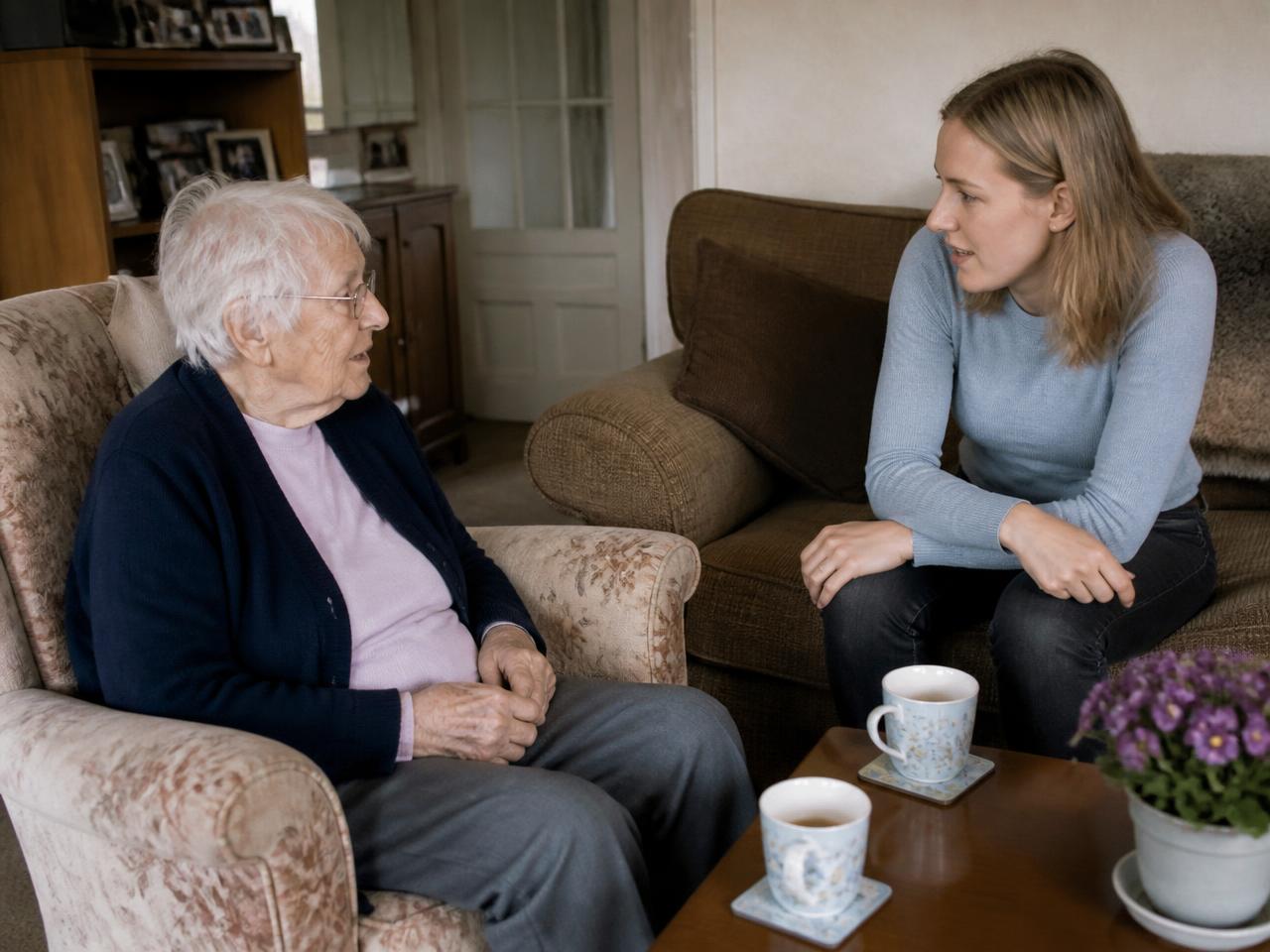
Living room in an ordinary home: an elderly person seated in an armchair talks with a relative sitting on the sofa, two cups on the coffee table.
Where the decision is actually made. A national signal becomes a concrete question : what do I change this week, and for whom.

MODULAR ADAPTATION

Behavior does not change
can be partial.

Nobody shifts from a “ protected ” state to an “ unprotected ” state. The documented adaptations are separable : a precaution on public transport, occasional remote work, particular care around a relative.

WHAT THE BINARY MODEL ASSUMES

A population split between those who follow the recommendations and those who do not.

WHAT THE SIMULATION SHOWS

Observed behaviors are partial: voluntary mask wearing in certain situations, interpersonal distancing, occasional spontaneous remote work.

WHAT THIS CHANGES

The same individual can reactivate one practice and reject another. Adoption is not measured as a state, but as a set of separable behaviors.

WHAT THIS IMPLIES FOR THE SETUP

A uniform message addresses a population that adjusts in fragments. A system for listening to actual behavior becomes a condition of calibration.

COMPARISON

The strategies tested,
assessed across three dimensions.

STRATEGYEFFECTIVE ADOPTIONACCEPTABILITYROBUSTNESS OVER TIME
01Firm, prescriptive national communicationlowlowlow
02Informative, responsibility-based communicationmediummediummedium
03Territorial prefectural cascadehighhighmedium
04Prefectural cascade + register validating observed self-regulationhighhighhigh

Qualitative comparison derived from the simulated strategies. The levels reflect documented gaps : 34 % versus 76 % effective adoption depending on the register, 42 % versus 68 % depending on the channel. No strategy is cost-free : a firm register produces a clear signal but feeds reactance in distrustful territories ; an informative approach limits social disruption but relies on unevenly distributed self-regulation ; the territorial cascade is more demanding to operate.

THE MOST ROBUST

Territorial prefectural cascade register validating observed self-regulation system for listening to actual behavior

THE MOST FRAGILE

Firm, prescriptive national messaging no territorial relay or observation of behaviors already adopted

DECISION

What the decision
selected.

TO RETAIN AS THE CHANNEL
The territorial prefectural cascade as the primary communication channel, rather than national messaging alone.
TO CHANGE IN THE REGISTER
Validate observed self-regulation rather than prescribe expected behaviors.
TO PUT IN PLACE
A system for listening to actual behavior through prefects, to adjust messages in real time.
TO TRAIN
Prefects trained in this communication register, which differs from classic setups.
DO NOT CALIBRATE TO
Opinion surveys, which structurally overestimate actual health-measure fatigue.

PROJECTION, THEN OBSERVATION

Then reality
happened.

The health authority integrated the results into its national preparedness setup for an epidemic-resurgence scenario. The validated setup retains the territorial prefectural cascade as the primary channel, a register validating observed self-regulation, a system for listening to actual behavior through prefects to adjust messages in real time, and dedicated training for prefects in this register.

The setup did not need to be activated during a real epidemic situation over the observation period. It was, however, used during two occasional health alerts : regional food contamination and an air-pollution alert. The results were consistent with projections, with adoption of recommendations 32 points higher than the conventional setups used during previous alerts.

The methodology was referenced in the national health-crisis preparedness plan. These values are those documented by the commissioning organization.

ACTIVATION IN AN EPIDEMIC SITUATION
the setup did not need to be activated during the observation period
USE IN OCCASIONAL ALERTS
two health alerts — regional food contamination, air pollution
ADOPTION OF RECOMMENDATIONS
+32 pts vs the conventional setups used in previous alerts
METHODOLOGICAL REACH
methodology referenced in the national health-crisis preparedness plan

TAKEAWAY

The problem
was not
to reactivate
old behaviors.
It was about understanding
which ones
what remained reactivatable.

The population did not react to the announced level of risk. It reacted to what it had already experienced, what it observed around it, and how public messaging positioned itself relative to a movement already under way. In 5 territories out of 10, adaptation precedes the announcement by 8 to 14 days : the institutional message does not initiate behavior, it confirms or opposes it.

Two consequences for public decision-making. Messages that validate observed behaviors achieve higher adoption than those that prescribe them — 76 % versus 34 % — which requires real-time observation rather than communication written in advance. And the asymmetry between stated fatigue (68 %) and behavioral fatigue (42 %) must be integrated into calibration : a setup sized to opinion surveys underestimates the population’s mobilizable capacities.

POSSIBLE FUTURES

The same signal.
Three response architectures.

A

REACTIVATE STRONGLY

Firm, prescriptive national communication close to the register used in the previous crisis

  • a very clear, immediately identifiable signal
  • 34 % effective adoption for the behavior-ahead register
  • 42 % average adoption for firm national messaging
  • accelerated reactance and fatigue in the most distrustful territories

B

INFORM AND EMPOWER

Limited communication leaving individuals to make their own trade-offs

  • low social disruption, low reactance cost
  • relies on real self-regulation, but unevenly distributed
  • only 5 territories out of 10 anticipate spontaneously
  • insufficient response among exposed populations with little room to adapt

C

TERRITORIALIZE AND VALIDATE

Territorial prefectural cascade, register validating observed self-regulation, listening to actual behavior

  • 68 % adoption for the prefectural cascade, versus 42 % for national messaging
  • 76 % adoption for the validating register, versus 34 % for the prescriptive register
  • +32 pts adoption observed during two real health alerts
  • requires permanent listening infrastructure and prefects trained in this register

METHOD

Before recommending,
we tested reactions.

  1. HEALTH SIGNAL
  2. POPULATION
  3. SCENARIOS
  4. REACTIONS
  5. SOCIAL INTERACTIONS
  6. 12-WEEK TRAJECTORIES
  7. DECISION

4,8 million reconstructed synthetic adults, 9 profiles of relationship to health risk, 4 200 individuals interviewed individually across 4 communication strategies, and behavioral trajectories projected over 12 weeks with modeling of territorial and intergenerational dynamics.

This case adds a capability to the library : simulating a population that has already experienced an event. Past event, learning, new event, modified reaction. The agents are not static respondents ; they carry memory, fatigue and thresholds that shift the response to the next signal.

A real case.
An unnamed health authority.

This case comes from a preparedness exercise conducted for a national health authority. The commissioning organization is not named, no personally identifiable data entered the system, and the detailed results remain its property. The comparisons between strategies published here are qualitative ; the quantitative values cited are those documented by the commissioning organization.

The simulation explores the behavioral reactions of synthetic populations to different epidemic-resurgence and public-response scenarios. It is neither epidemiological modeling, nor a health prediction, nor medical advice, nor an evaluation of the clinical or public-health effectiveness of a measure. The public decision belongs to the decision-maker.

Your next decision

Which decision do you want to explore?

Describe your need. We can point you to the right level of support.

What if you tested
your next decision?

State your decision. See the future it produces.

Explore the product